If you are planning a trip with four or more people, the first instinct is often to rent a villa. It sounds spacious and private, but the reality of running a large household in a strange city can be exhausting. Between managing the kitchen, coordinating everyone’s schedules, and being far from the main sights, a villa can sometimes feel like more work than a holiday. This is why looking closely at hotel accommodation in Dubai is a smart move, especially if you know how to read the room plan correctly. It is not just about finding a place to sleep; it is about finding a setup that actually functions for your family.
This guide will teach you how to look past the photos and understand the details that matter. We will walk through why a hotel can beat a villa for a group of four, how to decode bed configurations and real occupancy limits, and the difference between connecting and adjoining doors. We will also cover the logistics people forget, like laundry and meal timing, and help you weigh a hotel suite against a holiday home. Finally, we will apply these rules to properties like Jacob’s Garden Hotel and J5 Hotels, so you can use a practical checklist before you book. Start with configuration, not rate.
Why Hotel Accommodation in Dubai Can Beat a Villa for Four
Parents often equate square metres with sanity, then book a villa and inherit grocery runs, cooking, dishwashing and cleaning on a trip meant to be a holiday. In Dubai, the two are not just different sizes of the same thing: the Department of Economy and Tourism regulates hotel, holiday home and timeshare providers as separate categories. Hotel accommodation in Dubai typically hands a family of four daily housekeeping, a front desk that solves problems the same day, dining on site and a location closer to the sights you came for. Practically speaking, a villa often means a car for every errand, a kitchen you are expected to use, and housekeeping you request rather than receive automatically, all of which add effort to a trip. The point is not to dismiss villas. For longer stays or larger groups, they can make sense. For four, here is a method for reading a hotel room or suite plan so you can compare room, suite and villa on equal footing before booking.
Reading the Plan: Bed Configuration and Real Occupancy Limits
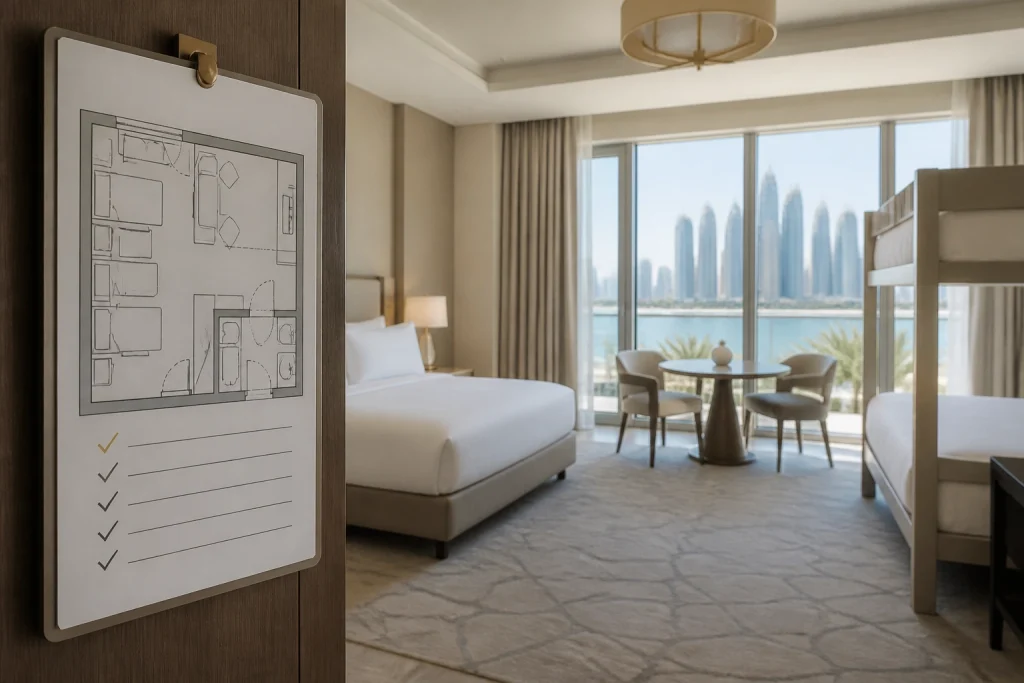
With that comparison in mind, read the room plan with the same scepticism you would apply to a villa listing. Start with occupancy as a number, not a feeling. A room listed as a double or twin is typically sold for two adults; whether a child can share existing bedding is a property policy, not a universal standard, always ask. Ask for the maximum occupancy in writing before you assume four people fit.
Bed types matter more than floor area. Ask what the fourth person actually sleeps on: a second queen, two twins, a sofa bed, or a rollaway added to the room. “Sleeps four” can mean four different things. Two connecting rooms give two bathrooms and a genuine bedtime split. One suite gives a single entry door and often a single bathroom, though the separate living area is usually where the sofa bed sits. Confirm whether that is a real mattress or a pull-out; it changes the trip for whoever sleeps on it. A two bedroom suite king or twin bed is worth reading line by line rather than trusting the name.
On the plan itself, note where the entry door opens, whether beds share a wall with a corridor, and where the window faces. These details decide how well a family sleeps. Treat any figure quoted on a listing page as a starting point to re-confirm with the property, because room dimensions, bed configurations and suite layouts vary across properties.
Connecting vs Adjoining Doors: What the Words Actually Mean
Connecting rooms share an internal door, so you can move between them without entering the corridor. Adjoining rooms are simply next to each other, with no internal access. If a confirmation says “adjoining”, assume you will be stepping into the hallway every time.
With young children, that difference is the whole point. A connecting door means reaching your child without entering the corridor; without one, every check means a walk down the hallway.
Ask three questions before you book:
- Do you have connecting rooms?
- Is the connection guaranteed at booking, or request only?
- Is there a supplement for the pairing?
Then ask about the door itself: does it lock from both sides, can the hotel unlock it for you on arrival, and how much noise passes between the two rooms?
Get it in writing. Put the request in the booking notes rather than relying on a phone call, book both rooms under one reservation where possible, and ask for the request to be confirmed back to you in writing. Confirmations use these terms loosely, so the written reply is your proof.
If a connecting door cannot be guaranteed, ask about two rooms on the same floor with the same housekeeping schedule. That is easier for a hotel to promise than a physical door.
Bathrooms, Laundry and Kitchenettes: The Logistics People Forget
Two rooms also buy you a second bathroom, which brings us to the part of the plan most families skim past.
Count bathrooms and ask about laundry
Count bathrooms, not bedrooms. Four people sharing one bathroom is the real morning bottleneck, and a second one is often worth more than extra floor space.
Laundry is the question nobody asks at booking and everyone has an opinion on by day three. Ask whether the property has guest laundry facilities, a charged per-item service, or a laundrette within walking distance. Do not assume an in-room washing machine is provided.
If you plan to feed children in the room, verify exactly what the kitchenette contains, this is checklist item 5. A second sink, a drying rack or a worktop beside the fridge changes more with a baby than extra carpet does.
For infants, ask about a cot or crib, where it will be placed, and whether there is space beside the beds. If laundry access is limited, pack a collapsible drying rack and travel laundry sheets. They weigh almost nothing and remove one chore from the itinerary.
Next, meal timing.
Meal Timing and Dining That Works Around Naps
Once laundry and kitchenette questions are settled, turn to food, because meal timing can make or break a nap. Ask for the actual breakfast sitting times, not the brochure version, and confirm whether children eat free or at a reduced rate. Child pricing often varies by property and age, so get the answer before you book.
Room service hours matter more than the menu. A jet-lagged toddler may want to eat at 5am, so ask whether anything is available at that hour and what it is. Then measure dining by walking distance from your room, not by the number of restaurants on site. A five-minute walk protects the nap schedule; a 20-minute stroller trek usually does not.
Note high chairs, menu options and allergy handling as questions for your pre-booking query. Time meals around your real day too. If you are out at a waterpark or the mall, ask what is open when you get back, not when the flagship restaurant starts service. Check the Dining Facilities page for an example of what to review, then confirm details with the property. Find the nearest supermarket or grocery delivery option so an early breakfast does not depend on service hours. With meal logistics clear, you can compare hotel accommodation in Dubai with a holiday home on equal terms.
Hotel Suite or Holiday Home: The Trade-Off Most Families Skip
Once meals are sorted, the bigger question is the property type itself. As noted above, these are separate regulated categories, the difference shows up in how you spend your time, not just your money (DET licensing rules).
Group size is the clearest filter. As a rule of thumb, holiday homes tend to make more sense for larger groups of six or more; four-person families may find they pay for space they rarely use.
Compare where the money goes. In a hotel you buy service, housekeeping, pool access and location. In a holiday home you buy space and self-catering. Total trip effort, not the nightly rate, is the fair measure. Check the commute too: two options can look close on a map and differ sharply on time to the beach, airport or attractions. A villa still wins for longer stays, multigenerational groups, or families who genuinely cook every day. Otherwise, read the room or suite plan first, as this guide to what a Dubai hotel room with a pool really gives you explains.
Applying the Method to Jacob’s Hotels & Resorts Properties
Jacob’s Hotels & Resorts is a useful test case because it runs both hotel accommodation and holiday homes. The group’s portfolio includes hotel properties in central Dubai areas alongside J5 Villas Holiday Homes.
Facilities such as dining, swimming pools and fitness areas are available across the group, but vary by property. Al Raffa and Al Muraqqabat are located in central Dubai areas; check proximity to shopping and dining options directly with the property. The Barsha Gardens and Mirdif villas are holiday home properties, which by their nature suit a self-catering approach rather than a fully serviced hotel stay.
Verify the details that matter: bed configurations, maximum occupancy, connecting or adjoining rooms, suite layouts, laundry access and kitchenette contents vary by property and are not confirmed by the group, so put each checklist question to the property directly. If a workday overlaps the trip, the group’s meeting room hire in Dubai guide covers location and facilities in Deira and Al Raffa.
You can compare a Deira hotel room or suite with the group’s own Barsha Gardens or Mirdif villas using the same checklist. That is the point of one method instead of two. The property list and facility description are provided by the operator, so confirm specifics at the time of booking.
Hotel Room Booking in Dubai: A Pre-Booking Checklist for Families
Whichever Jacob’s property or villa you shortlist, put the same questions to each before you pay. Use this eight-point checklist for hotel room booking in Dubai, and ask for every answer in writing.
- Occupancy: Does the room officially sleep four? What age counts as a child rather than an adult? Will the property confirm both in writing?
- Extra beds and cots: Is a rollaway or crib available, is it charged, and does it fit beside the beds? Is there an infant age limit or extra-bed fee that changes the total?
- Connecting doors: Put the request in the booking notes and ask for written confirmation. Is the connection guaranteed, or on request only?
- Bathrooms: How many are there, and can any room or suite combination add a second one at a comparable rate?
- Laundry and kitchenette: Is there guest laundry, a per-item service or a nearby laundrette? If you plan to feed children in the room, ask exactly what the kitchenette contains.
- Meals: Confirm breakfast sitting times, child pricing, room service hours, high chair availability and how allergies are handled.
- Flexibility: Read the cancellation and date-change policy, in case flight times or school dates move after you book.
- Final step: Send this whole list as one written query before you pay, and keep the reply.
A property that answers every item clearly before you pay is a good sign. For more traps to sidestep, read common mistakes to avoid when booking a hotel in Dubai.
What to Do Before You Book
You now have your eight answers, so use them to make the final call. Do not book on floor area alone. Book on configuration: what the fourth person actually sleeps on, how many bathrooms you get, whether the connecting door is guaranteed, and when breakfast is served. Treat every room listing as a starting point, not a specification. Confirm everything in writing as set out in the checklist above.
Weigh the villa option on running effort as covered in the trade-off section. Run the same checklist across a hotel room, a suite and a holiday home. Same questions, same standard, better decision. If a villa stays in the mix, this guide to family villas in Al Barsha and Mirdif helps you match the area to your trip.
Conclusion
Reading a Dubai hotel room well comes down to a few essentials. Configuration matters more than floor area, so always ask what the fourth person actually sleeps on. Match the accommodation to your trip: a hotel room or suite for shorter stays and daily housekeeping, a holiday home for longer visits where cooking is the plan. Confirm every detail in writing, from bed setup to breakfast timing, and treat the listing as a starting point rather than a spec. Run the same checklist across every option, including the Jacob’s Hotels & Resorts properties, so you compare like for like. The payoff is a family trip that starts smoothly instead of one spent solving problems on arrival. Book the configuration before the rate, and let the room work for you.